Why a Falling Month-to-Date Refund Rate Isn’t Always Good News
A falling month-to-date refund rate may not signal improvement. Learn why refund lag distorts the number and how to read it correctly in Metly.
The Refund Lag Effect: Why the Number Isn’t What It Seems
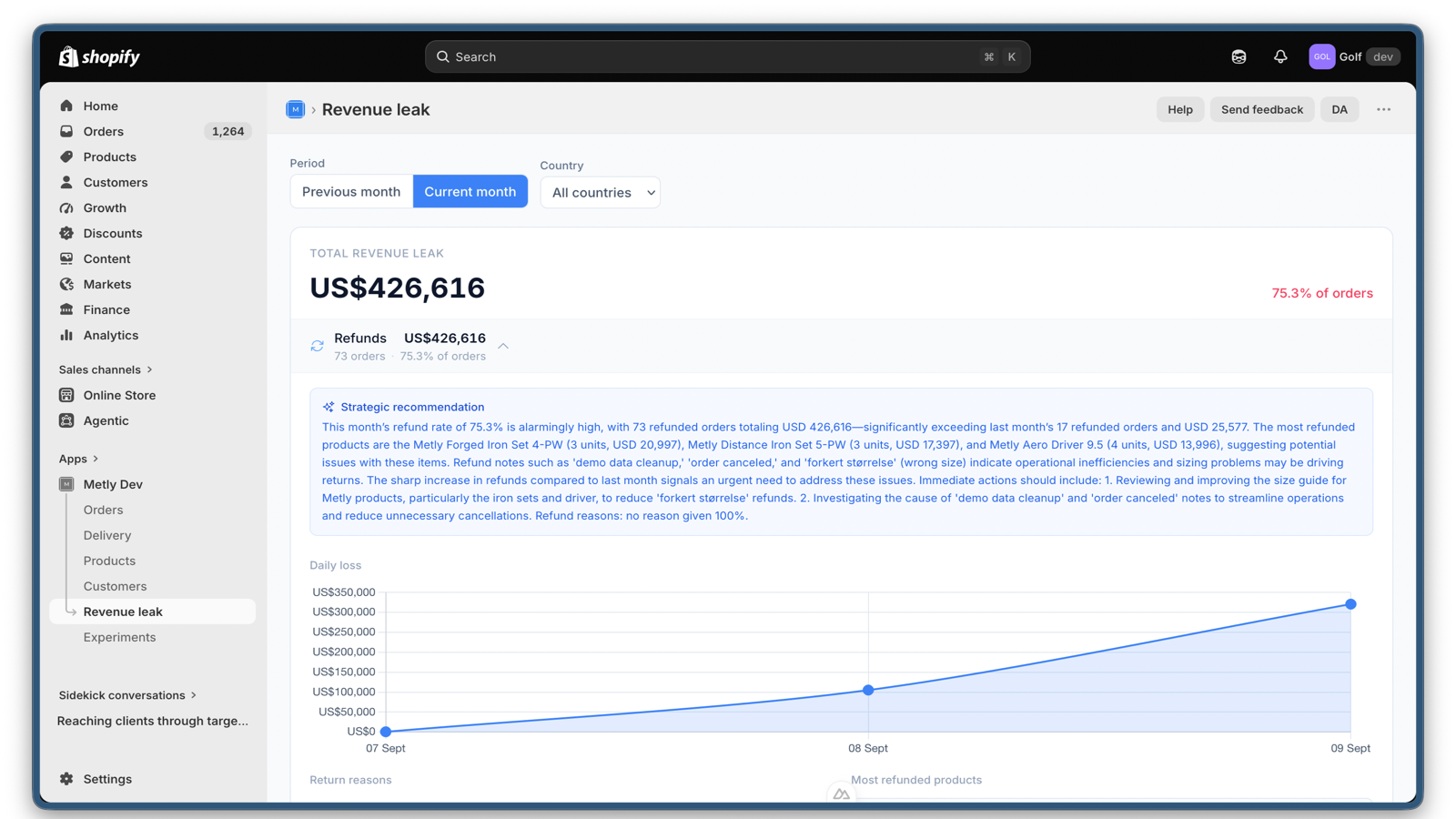
A month-to-date refund rate that falls from one period to the next can feel like a win. If the rate drops from 5% to 3%, it’s tempting to assume customer satisfaction is improving or return policies are working better. But in reality, this number is often misleading. The reason lies in refund lag—the delay between when an order is placed and when a refund is issued. Metly’s methodology shows that refunds typically land 10-20 days after the order, meaning a month-to-date refund rate is always immature. A drop in the rate may simply reflect that fewer refunds have been recorded yet, not that fewer refunds will ultimately occur.
For example, the synthetic Demo store shows a refund rate of 3% month-to-date this month, down from 5% for the same days last month. At first glance, this looks like progress. But because refunds take time to process, the lower rate could just be a lag artifact. The real story won’t be clear until the full refund cycle plays out.
How Metly Handles Refunds in Metrics
Metly’s net revenue—the money a store keeps after excluding cancelled, refunded, failed, and voided orders—is the canonical revenue basis across the app. This means refunds directly impact the bottom line, but their timing complicates short-term analysis. The same-day cutoff rule ensures fair comparisons: month-over-month metrics always compare days 1-N of the current month to days 1-N of the previous month. This prevents distortions from partial data, but it doesn’t eliminate the lag inherent in refund reporting.
The blended revenue metric offers a workaround by combining actual revenue so far with a forecast for the remainder of the month. However, it’s always shown with the actual/forecast split, never as a single claimed fact. This transparency helps merchants avoid overinterpreting early trends, especially when refunds are involved.
What a Falling Refund Rate Might Mean
A declining month-to-date refund rate isn’t meaningless—it’s just incomplete. Possible explanations include:
- Fewer refunds issued so far: The lag effect means some refunds haven’t been recorded yet. The rate could rise as more come in.
- Seasonal or operational changes: If a store recently adjusted its return policy, shipping times, or product quality, the impact may not be fully visible yet.
- Stockouts or oversells: A stockout (when a product sells out and isn’t restocked) can reduce refunds by limiting the number of orders that could later be returned. Conversely, overselling (selling more units than available) can artificially inflate refunds if customers cancel unfulfilled orders. Metly observes overselling as negative available stock, but this is only a shortfall if the variant’s inventory policy is set to DENY. For sunset products or pre-orders (where the policy is CONTINUE), overselling is deliberate and doesn’t trigger stockout prevention.
How to Read the Number Correctly
To avoid misinterpreting a falling month-to-date refund rate, merchants should:
- Wait for maturity: Refund rates stabilize only after the full refund lag period (10-20 days). Early trends are unreliable.
- Compare to forecasts: Metly’s pre-change forecast provides a counterfactual to measure experiments against. If the refund rate falls below the forecast, it’s worth investigating—but only after the lag period.
- Check for external factors: A drop in refunds might coincide with a drop in orders, which isn’t a win. Look at net revenue and estimated product sales (month-to-date actual units plus the per-product forecast remainder) to see the full picture.
- Review inventory policies: If refunds are falling because products are selling out, it could signal missed sales opportunities. Metly’s oversell versus stockout tracking helps distinguish deliberate pre-orders from unintended shortfalls.
Industry Context: Why Refunds Matter
Refunds are a critical part of ecommerce, but they’re often overshadowed by metrics like cart abandonment. The Baymard Institute’s research—a general industry figure, not specific to any store—shows that roughly 70% of online shopping carts are abandoned before purchase, often due to unexpected costs like delivery fees. While this isn’t directly tied to refunds, it highlights how small friction points can impact customer behavior. A high refund rate might indicate similar issues, such as unclear product descriptions, slow shipping, or mismatched expectations.
The Bottom Line
A falling month-to-date refund rate isn’t inherently good or bad—it’s a signal that needs context. Refund lag means the number is always a work in progress, and merchants should avoid celebrating (or panicking) too soon. By combining Metly’s net revenue, blended revenue, and pre-change forecast tools, store owners can separate real improvements from temporary fluctuations. The key is to wait for the data to mature, then act on the full story—not just the early draft.